Explainer
Is E471 Halal? Mono- and Diglycerides, Explained
E471 turns up in bread, ice cream and margarine, and the label almost never says whether it came from plants or animals. Here is why Doubtful is often the honest answer.
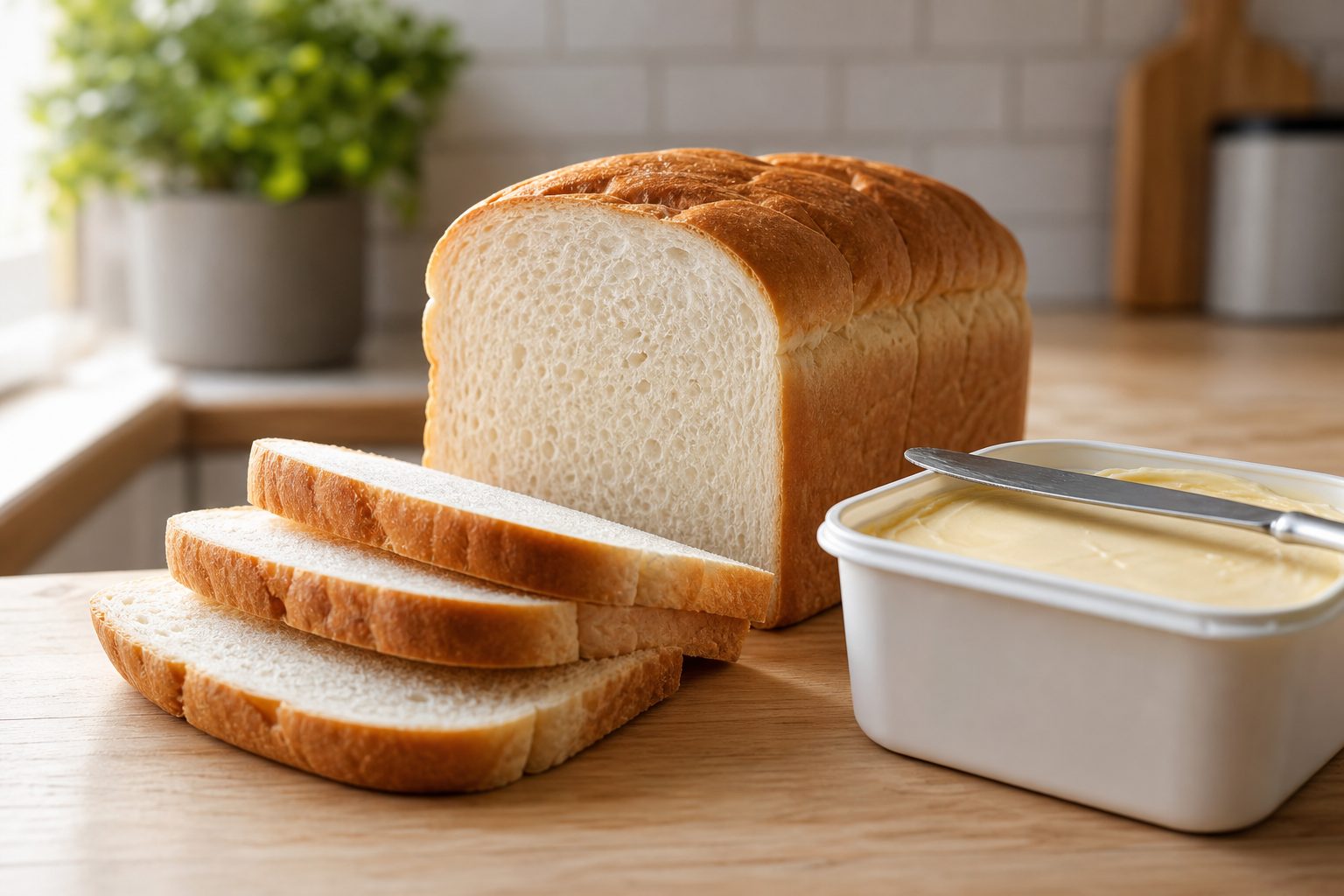
Is E471 halal? It depends on what it was made from, and the label almost never tells you. E471 is the code for mono- and diglycerides of fatty acids, an emulsifier built from glycerol and fatty acids that can come from vegetable oils or from animal fat, including pork fat. Made from plants, the source question is settled. Made from animal fat, it depends on the animal and how it was slaughtered. When the label is silent, as it usually is, it is commonly treated as Doubtful (Mashbooh) until the source is confirmed.
This explainer covers what E471 does, why the same code can hide two very different raw materials, what can change the answer, and the exact questions to send a manufacturer.
What E471 is, and why it’s in so much food
Mono- and diglycerides are glycerol with one or two fatty acids attached. That structure gives them a fat-friendly end and a water-friendly end, which is exactly what an emulsifier needs: it helps oil and water stay evenly mixed instead of separating.
In the US, the FDA describes them as prepared “from fats or oils or fat-forming acids that are derived from edible sources,” and lists uses ranging from emulsifier and stabilizer to dough strengthener and texturizer (21 CFR 184.1505). In the EU, the European Food Safety Authority’s 2017 re-evaluation notes that E471 is authorised in 84 food categories (EFSA Journal, 2017).
In a shopping basket, that means sliced bread, cakes and pastries, ice cream, margarine and spreads, coffee creamer and peanut butter. It is an ordinary workhorse ingredient with many jobs, which is why it appears on so many labels.
E471 plant or animal: one code, two routes
Manufacturers make mono- and diglycerides by reacting glycerol with fats, oils or fatty acids. Those starting fats can be vegetable oils, or they can be animal fats such as beef tallow or pork fat. What comes out the other end is the same kind of molecule, so the finished ingredient carries the same name and the same code whichever route was used.
The label doesn’t close that gap. Under EU food-information rules, an additive in a category such as “Emulsifier” is declared by that category name followed by its specific name or E-number (Regulation (EU) No 1169/2011, Annex VII Part C). “Emulsifier: E471” is a complete, legal declaration, and it says nothing about the raw material.
| What the label says | What it tells you | What to do next |
|---|---|---|
| “Emulsifier: E471” or “mono- and diglycerides” | The function and the substance. Nothing about the source. | Treat as Doubtful until confirmed. |
| “Vegetable mono- and diglycerides” or “E471 (plant origin)” | The manufacturer states a plant source. | A strong signal. Ask if you also want to know about shared equipment. |
| “Suitable for vegans” | The manufacturer claims no animal-derived ingredients. | A useful hint, but it’s a claim, not a halal certification. |
| A halal certification mark | A certifier says it has checked the ingredient sources. | Check which certifier, and whether you trust its standards. |
Why “Doubtful (Mashbooh)” is the honest default for E471
A good halal check gives four possible outcomes, not two:
- Halal when the ingredient is permissible or its source is confirmed.
- Doubtful (Mashbooh) when the answer depends on information the label doesn’t give.
- Haram when the ingredient itself is clearly impermissible, such as lard.
- Unknown when there isn’t enough information to judge at all.
Unlabelled E471 fits Doubtful exactly. Calling it Halal would assume a plant source nobody has confirmed. Calling it Haram would assume an animal source nobody has confirmed either. Doubtful is simply an accurate description of what the label can prove.
Certifiers treat it the same way. IFANCA’s Halal Shopper’s Quick Reference Guide lists mono- and diglycerides among its examples of mashbooh ingredients, in products from bread and cake to ice cream, shortening and peanut butter, and its advice is to call the manufacturer and confirm (IFANCA, PDF).
Scholars also differ. Some who take a broad view of istihala (complete chemical transformation) may permit E471 whatever its origin. Others, and certifiers such as IFANCA, want the source confirmed first. How you act on a Doubtful result is a personal decision, ideally made with a scholar you trust. Some people avoid mashbooh items altogether, and others check further first.
What changes the answer
- Plant-source wording. “Vegetable,” “plant-based” or a named oil next to E471 is the manufacturer telling you the route. It resolves the main question.
- A certification claim, checked. A halal mark means a certifier reviewed the sources. Look up who the certifier is, because standards differ between bodies.
- A manufacturer’s confirmation. A written reply naming the source is often the most direct answer you can get, especially for one specific product.
- A recent label. Recipes and suppliers change. A confirmation from two years ago, or for a different country’s version, may not hold today.
E472a–f and other relatives of E471
The E472 family is E471 combined with a food acid: acetic acid esters are E472a, lactic E472b, citric E472c, tartaric E472d, mono- and diacetyl tartaric E472e (often called DATEM, and common in bread) and mixed acetic and tartaric E472f. The acid part isn’t the concern. The glycerides underneath can still be plant- or animal-derived, so E472 raises the same source question as E471.
Polyglycerol esters (E475) and PGPR (E476, common in chocolate) are also built on glycerol, so they raise a similar source question, although PGPR’s fatty-acid part comes from castor oil. For a wider view of codes that depend on their source, see our halal E-numbers list.
Questions to ask the manufacturer about E471
A specific question gets a clearer reply than “Is this halal?” Include the product name, pack size and, if you can, the barcode and batch code. Copy what you need:
- Are the mono- and diglycerides (E471) in this product made from plant oils or from animal fat?
- If any animal fat is used, which animal is it from, and was it slaughtered according to halal requirements?
- Does the same answer apply to any E472 emulsifiers, dough conditioners or flavouring carriers in the product?
- Is the product covered by a halal certificate? If so, which certifier issued it, and is it current?
- Is the source the same in every factory and country where this product is made?

If the reply is vague, it is fine to keep the product in the Doubtful column. For the full shopping routine, from certification marks to clear haram ingredients, see how to check if a product is halal.
How SahihScan shows E471
SahihScan, our app for iOS and Android, does this label reading for you and shows its working. You scan a barcode, and the ingredients are looked up in Open Food Facts (open data under the ODbL). If there’s no barcode, or the product isn’t there, you can photograph the ingredients panel or type it in.
Common spellings such as “E471,” “E-471,” “mono and diglycerides,” “glyceryl monostearate” and “distilled monoglycerides” all match the same knowledge-base entry. That entry is Doubtful and flagged as source-dependent. Tap the ingredient and the reason reads, in plain language, that it can be made from vegetable oils or animal fat including pork, and that labels almost never state which. Behind the entry, the knowledge base references the published positions of several certification bodies. They are cited, not partners.
Because E471 is source-dependent, the result also lists it under Questions for the manufacturer, asking whether it is plant-based, microbial or animal-derived. If Open Food Facts records a halal label for the product, a chip reads “Manufacturer claims halal certification — verify the certifier.” The app never treats that claim as proof on its own. If the app can’t reach its server, it falls back to the knowledge base bundled on your phone and labels the result a rule-based verdict; AI analysis needs a connection. Every result ends with the disclaimer below, and the 331-entry knowledge base is still undergoing scholarly review.
Please note: SahihScan provides ingredient information, not religious rulings. Formulations change — when in doubt, check with the manufacturer or a qualified scholar.
SahihScan's ingredient knowledge base is still undergoing scholarly review. Certifiers are named for their published guidance only, which does not imply endorsement or partnership.
Frequently asked questions
Is E471 always haram?
No. E471 is not haram by definition; its status depends on what it was made from. Plant-derived E471 raises no source concern. Animal-derived E471 depends on the animal and how it was slaughtered. When the label does not say, as is usual, it is commonly treated as Doubtful (Mashbooh) until the source is confirmed.
Is E471 vegan or vegetarian?
It can be either, because the same code covers plant-derived and animal-derived versions. A vegan claim on the pack is a useful hint that the manufacturer is not using animal fat, but it is the manufacturer's claim, so ask if you need certainty.
Is E471 safe to eat?
Food safety and halal status are separate questions. The European Food Safety Authority re-evaluated E471 in 2017 and concluded it was of no safety concern at the reported uses and use levels. For any personal dietary or medical question, speak to a doctor or dietitian.
Is E472e (DATEM) halal?
E472e is made from mono- and diglycerides combined with tartaric and acetic acids, so it carries the same source question as E471. It is commonly treated as Doubtful unless the glycerides are confirmed plant-based or the product is certified by a certifier you trust.