Reference
Halal E-Numbers List: Which Additives Are Doubtful, and Why
Most ‘haram E-numbers’ lists are flat yes/no charts. This one explains which codes depend on their source, where certifiers disagree, and why no list can be final.
This halal E-numbers list sorts common additives by why they matter, not just yes or no. Many codes raise no halal question at all: they are minerals, synthetic compounds or plant extracts. A smaller group, including E441, E422, E471, E542, E570 and E920, may be made from animal material, and the label rarely says which source, or which animal, was used. Those stay Doubtful until the source is known. Two more, E120 carmine and E904 shellac, are Doubtful for a different reason: halal certifiers disagree about them.
Every verdict below comes from SahihScan’s ingredient knowledge base, the same one the app uses when it reads a label. Each reason is kept to one line, and we’ve been plain about where a list like this stops being useful.
How to read this halal E-numbers list
Each row shows its verdict the way the app does, with an icon and a word, never colour alone:
- Halal no source or certifier concern recorded.
- Doubtful depends on an unstated source, or authorities differ.
- Haram prohibited, such as anything from pork.
- Unknown not enough information to say.
Two things to keep in mind. First, SahihScan’s knowledge base is still undergoing scholarly review, so read these as documented reasoning, not rulings. Second, an E-number is a food-safety label, not a halal one. The UK Food Standards Agency explains that an additive is approved only if it has been proved safe for its intended use, there is a technological need for it, and it doesn’t mislead consumers (FSA guidance on food additives). None of those conditions is about whether it came from a plant or an animal.
One figure is worth knowing. Of the 145 E-numbered entries in the knowledge base, 110 are listed Halal, 35 Doubtful and none Haram. The Haram verdicts come from named ingredients, such as pork gelatin or lard. That is why a flat chart of ‘haram E-numbers’ can mislead: many of the codes such charts flag are ones whose source simply isn’t stated.
Source-dependent E-numbers: Doubtful until the source is known
These additives can come from plants, microbes, synthesis or animals. The ones that are always animal-derived, such as gelatin and bone phosphate, can come from different species slaughtered in different ways. The code stays the same whatever the source, so it can’t tell you which.
| Code | Additive | Verdict | Why it depends on the source |
|---|---|---|---|
| E441 | Gelatin (unspecified) | Doubtful | Made from animal skin and bone; labels rarely name the species or slaughter. Fish gelatin is listed Halal, pork gelatin Haram. |
| E422 | Glycerin (glycerol) | Doubtful | Made from vegetable oils, petrochemicals or animal fat. Vegetable glycerin is listed Halal. |
| E471 E472a–f | Mono- and diglycerides and their esters | Doubtful | Built from fats that can be plant or animal, including pork. See Is E471 halal? |
| E542 | Edible bone phosphate | Doubtful | Ground animal bone, so it depends entirely on the animal and how it was slaughtered. |
| E570 | Stearic acid (fatty acids) | Doubtful | From palm or coconut oil, or from tallow or lard. The label almost never says. |
| E920 | L-cysteine | Doubtful | A dough conditioner made synthetically, by fermentation, or extracted from feathers or hair. |
| E627 E631 E635 | Guanylates, inosinates, ribonucleotides | Doubtful | Savoury flavour enhancers made by fermenting yeast or starch, or derived from fish or meat. |
E471 is the one you’ll meet most, in bread, ice cream and margarine, so it has its own explainer: Is E471 halal? Mono- and diglycerides, explained. And a note on E441: neither it nor E542 appears on the UK’s list of approved additives and E numbers, so on UK labels gelatin usually appears as a word, not a code.
What turns Doubtful into an answer is information: a halal mark from a certifier you trust, a manufacturer who confirms the source, or wording such as ‘vegetable mono- and diglycerides’ or ‘fish gelatin’ on the pack itself.
Where certifiers disagree: E120 carmine and E904 shellac
These two aren’t Doubtful because the source is hidden. Everyone knows where they come from. They’re Doubtful because respected halal authorities have reached different conclusions.
E120 carmine (cochineal)
Carmine is a red colour made from the cochineal insect. The European Food Safety Authority re-evaluated cochineal, carminic acid and carmines as food additive E120 in 2015 (EFSA’s opinion on E120). Indonesia’s MUI issued Fatwa No. 33 of 2011 holding that cochineal colouring is halal as long as it is beneficial and not harmful; its published reasoning compares the insect to the grasshopper, noting that its blood does not flow and that it feeds on plants. South Africa’s SANHA, by contrast, lists E120 as Haraam, citing its insect source. SahihScan lists carmine as Doubtful and shows the reasoning; it doesn’t choose a side for you.
E904 shellac (confectioner’s glaze)
Shellac is a resin secreted by the lac insect, used to put a shine on sweets, chocolates and pills. The knowledge base records a genuine split: some bodies accept it as a secretion, the way beeswax is accepted, while others avoid it over its insect origin and the ethanol solvent used to apply the glaze. It is listed Doubtful for that reason.
E-numbers the knowledge base lists as Halal
These examples raise no slaughter or source question in the knowledge base, and no recorded certifier disagreement. Pay attention to the lecithin rows.
| Code | Additive | Verdict | Reason |
|---|---|---|---|
| E300 | Ascorbic acid (vitamin C) | Halal | Made industrially from glucose, typically from corn. |
| E330 | Citric acid | Halal | Made by fermenting sugars with the mould Aspergillus niger. |
| E901 | Beeswax | Halal | A bee product, like honey; no slaughter is involved. |
| E132 | Indigotine | Halal | A wholly synthetic blue dye. |
| E322 | Soy or sunflower lecithin | Halal | Plant lecithins, with the source named on the label. |
| E322 | ‘Lecithin’ with no source | Doubtful | Almost always soy, sunflower or rapeseed, but an undeclared source can’t be assumed. |
The code is identical in both lecithin rows. What changes the verdict is whether the label names the source.
Why no halal E-numbers list can be final
Treat any list, this one included, as a starting point.
- Suppliers change. A manufacturer can switch between a plant-based and an animal-based E471 without the code changing.
- Regions differ. A product sold under the same name in two countries can be made to different recipes.
- Recipes are reformulated. Re-check the products you buy every week, not just new ones.
- Wording matters. ‘Emulsifier (E471)’, ‘E-471’ and ‘mono- and diglycerides’ are the same thing; ‘lecithin’ and ‘soy lecithin’ are not.
- Certification is product-specific. A halal mark covers that product, to that certifier’s standard. It doesn’t clear the code everywhere else.
For a step-by-step method that works in any aisle, see how to check if a product is halal.
Letting a scanner decode the codes
SahihScan, our app for iOS and Android, does this list’s work at the shelf. You photograph the ingredients panel, scan a barcode or type the list in. Before anything is judged, an ingredient normalizer rewrites the label into a form the knowledge base can match: it reads ‘Emulsifier: E471’ as E471, treats ‘carmine E120’ as one ingredient named twice, and copes with variants such as E 471, E-471 and E160(a).
Each ingredient is then matched against the knowledge base, which ships inside the app: 331 entries, 214 Halal, 94 Doubtful and 23 Haram, all still undergoing scholarly review. Knowledge-base verdicts take priority. Anything it doesn’t recognise goes to an AI model that is instructed to answer Doubtful or Unknown when it is uncertain, and never to guess Halal. The overall result follows the strictest ingredient, and each one expands to show its reason. Without a connection, the bundled knowledge base still gives a rule-based verdict; AI analysis needs the internet. Barcode lookups use product data from Open Food Facts, shared under the Open Database License. When a product isn’t there, the label photo works instead.
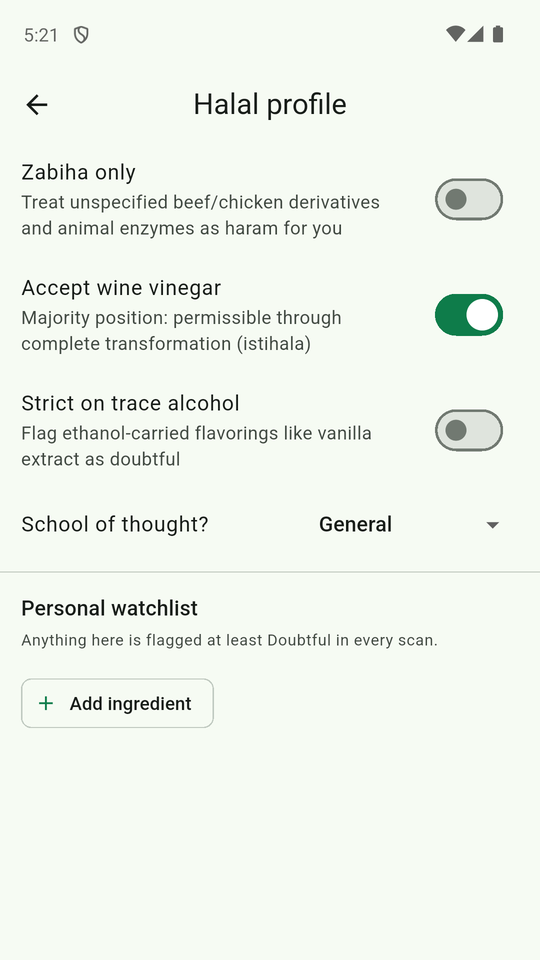
Your own practice comes in through the Halal profile. If you avoid an additive this list marks Halal, beeswax for example, add it to your personal watchlist and it will be flagged at least Doubtful in every scan. The strict-zabiha and trace-alcohol settings adjust verdicts in the same way, only ever making them stricter.
Please note: SahihScan provides ingredient information, not religious rulings. Formulations change — when in doubt, check with the manufacturer or a qualified scholar.
SahihScan's ingredient knowledge base is still undergoing scholarly review. Certifiers are named for their published guidance only, which does not imply endorsement or partnership.
Frequently asked questions
Which E-numbers are haram?
In SahihScan’s knowledge base, none is Haram by code alone: none of the 145 entries that carry an E-number is listed Haram. The codes to watch are the Doubtful ones: source-dependent additives such as E441, E471, E542 and E920, plus E120 and E904, where certifiers disagree. Haram verdicts in the knowledge base come from named ingredients such as pork gelatin or lard.
Is E120 carmine halal?
Certifiers differ. Indonesia’s MUI issued a fatwa in 2011 treating cochineal colouring as halal as long as it is beneficial and not harmful, while South Africa’s SANHA lists E120 as haraam. SahihScan lists carmine as Doubtful and shows why; which view to follow is a question for a scholar you trust.
Is E441 gelatin halal?
It depends on the source. Gelatin with no stated source is listed Doubtful because it may come from pork or from cattle that were not slaughtered the halal way. Fish gelatin is listed Halal and pork gelatin Haram. Beef gelatin is listed Doubtful unless certified, because most certifiers require the animal to have been slaughtered Islamically.
Is E920 L-cysteine halal?
Only once the source is known. L-cysteine can be made synthetically, by fermentation, or extracted from feathers or hair. The certifier positions recorded in SahihScan’s knowledge base accept synthetic and fermentation-made L-cysteine and reject human-hair material, so an unspecified E920 stays Doubtful until the manufacturer confirms the source.