Guide
How to Check if a Product Is Halal: A Label-Reading Guide
A six-step label check that works with or without an app, and why ‘Doubtful’ and ‘Unknown’ are useful answers rather than failures.
The quickest way to check if a product is halal is to look for a certification mark from a body you can verify, then read the ingredient list for three things: ingredients that are clearly haram, ingredients whose source the label doesn't state, and E-numbers that can hide either. If the label settles every ingredient, you have your answer. If it doesn't, the honest answer is Doubtful or Unknown, and the next step is a question to the manufacturer.
It doesn't take a chemistry degree, just a system: the same few ingredients cause most of the confusion, and labels are written to meet food law, not to answer halal questions.
How to check if a product is halal in six steps
Work through them in order. Each step either settles the question or narrows it down to one ingredient you can ask about.
- Find the certification mark and check who issued it.
- Scan for the clearly haram ingredients.
- Flag the source-dependent ingredients.
- Decode the E-numbers.
- Ask when the answer is Doubtful or Unknown.
- Re-check over time.
Step 1: Find the certification mark, then check who issued it
A halal certification mark means an independent body has reviewed the ingredients and, usually, the production site. That's information the ingredient list can't give you, which is why the mark comes first. But a mark is only as meaningful as the body behind it, so three habits help:
- Name the certifier. A real mark identifies an organisation. The word “halal” printed on its own, with no body named, is the manufacturer's claim, not a certificate.
- Look it up on the certifier's own site. Many publish directories. IFANCA, whose mark is the Crescent-M, has a searchable certified products list, and Malaysia's JAKIM runs the Halal Malaysia portal for checking certified products and premises. Use the certifier's site, not a reseller's page.
- Match the product, not just the brand. Certification covers specific products. One flavour can be certified while another from the same brand isn't, and an imported version may be made to a different recipe.
Certifiers' standards aren't identical, and some families prefer particular bodies; a qualified scholar can help you think that through. No mark, or one you can't verify? Move on to the ingredients.
Step 2: Scan for the clearly haram ingredients
Start with the short list of ingredients that settle the question on their own. Pork and its derivatives are prohibited, and alcohol deliberately added as an ingredient is treated as an intoxicant; SahihScan's knowledge base lists all four below as Haram. On a label, they usually appear as:
- Pork gelatin Haram gelatin made from pig skin or bones.
- Lard Haram rendered pig fat, found in some pastry and baked goods.
- Porcine pepsin Haram a digestive enzyme taken from pig stomach lining.
- Ethanol or alcohol listed as an ingredient Haram alcohol added on purpose, as opposed to a trace left over from processing.
Trace alcohol, such as the little left from vanilla extract, is a separate question where views differ; it comes up in step 5.
Step 3: Flag the ingredients that depend on their source
This is where most of the real uncertainty lives. These ingredients can be made from plants, microbes, synthetic routes or animals, and a label usually names the ingredient without saying which. Food law doesn't require it: in the US, a “natural flavor” can come from plants but also from meat, seafood, poultry, eggs or dairy.
| As printed | Why it's unclear | What settles it on the label | If the label is silent |
|---|---|---|---|
| Gelatin E441 | May come from pork, conventionally slaughtered cattle or fish | “Fish gelatin”, or a verified halal mark | Doubtful |
| Glycerin / glycerol E422 | Made from vegetable oils, petrochemicals or animal fat | “Vegetable glycerin” | Doubtful |
| Mono- and diglycerides E471 | Built from fatty acids that can come from plant oils or animal fat | A stated plant source, or a verified mark | Doubtful |
| Natural flavors | Can be animal-derived, and may be carried in alcohol | Only the manufacturer or a certificate | Doubtful |
| Enzymes | Microbial, plant or animal | A stated microbial or plant source | Doubtful |
| Rennet, cheese, whey | Animal rennet may come from an animal not slaughtered Islamically; whey inherits the question | “Microbial rennet” | Doubtful |
| Shortening | May include lard or beef tallow | “100% vegetable shortening” | Doubtful |
E471 is among the most common emulsifiers in packaged food; our explainer Is E471 halal? covers it in detail.
Step 4: Decode the E-numbers
In the UK and EU, additives are listed by what they do, followed by their name or E-number, as the Food Standards Agency explains. So the same additive might read “emulsifier (E471)” on one pack and “emulsifier (mono- and diglycerides of fatty acids)” on another.
Most E-numbers raise no halal question at all. Citric acid E330 is made by fermenting sugars with a mould, and beeswax E901 is a bee product. A smaller group needs a second look:
- Source-dependent codes. E441 gelatin, E422 glycerin, E471 mono- and diglycerides, E542 edible bone phosphate, E570 stearic acid and E920 L-cysteine can all be made from animals, and the label rarely says which source was used. Most of these also have plant, microbial or synthetic routes; bone phosphate is always made from animal bones, so the question there is which animal.
- Codes where certifiers disagree. Carmine E120, a red colour from cochineal insects, and shellac E904, a glaze secreted by the lac insect, are treated differently by different halal authorities. We list both as Doubtful for that reason, rather than picking a side.
Our halal E-numbers list covers these codes one by one, with the reason each is flagged.
Step 5: When the answer is Doubtful or Unknown, ask
After four steps, the product lands in one of four places:
- Halal every ingredient is recognisably permissible, or the product carries a mark you've verified.
- Doubtful (Mashbooh) at least one ingredient could be halal or not, and the label doesn't say which.
- Haram at least one ingredient is clearly prohibited.
- Unknown something on the list can't be identified, so no honest verdict is possible yet.
Doubtful and Unknown can feel like failures, but they're precise: they point to the exact ingredient in question. Contact the manufacturer through the customer-care details on the pack and ask about that ingredient.
- Is the [ingredient] plant-based, microbial, synthetic or animal-derived?
- If it is animal-derived, which animal, and was it slaughtered according to Islamic requirements?
- Are any flavourings carried in alcohol, and does any alcohol remain in the finished product?
- Is this product halal-certified? If so, by which body, and does the certificate cover the version sold in my country?
- Has the recipe changed recently?
Practice genuinely differs, too. Some Muslims avoid anything Doubtful until it's confirmed. Others follow the majority position on particular questions: that wine fully turned into vinegar has become a new, permissible substance (istihala), for example, or that the trace of alcohol left from vanilla extract in a finished food isn't consumed as an intoxicant. Stricter views avoid both. Neither approach needs defending to anyone else, and a qualified scholar you trust is the right person to ask if you're unsure.
Step 6: Re-check over time, because recipes change
A product you checked last year may not be the same product today. Manufacturers reformulate and change suppliers, one brand can use different recipes in different countries, and certifications can lapse or change. Re-check when:
- the packaging is redesigned, or says “new recipe” or “improved”;
- the product is imported, or you're buying it abroad;
- a certification mark appears or disappears;
- you haven't bought it for a few months.
A halal ingredients checklist for your next shop
- Mark. Is there a halal mark, and does it name a certifier I can look up?
- Directory. Have I checked the certifier's own site for this exact product?
- Clear haram. Any pork gelatin, lard, porcine pepsin or alcohol listed as an ingredient?
- Source unstated. Any gelatin, glycerin, natural flavors, enzymes, rennet, whey or shortening without a stated source?
- E-numbers. Any I don't recognise, especially E120, E422, E441, E471, E542, E570, E904 or E920?
- Still unsure. Is anything Doubtful or Unknown? Note the ingredient and ask the manufacturer.
- Changes. Has the pack, recipe or mark changed since I last checked?
Doing it in one scan with SahihScan
We built SahihScan to run this same check and show its working, not a bare yes or no. It is available on iOS and Android:
- Scan the barcode. SahihScan looks the product up in Open Food Facts, the open food database, used under the Open Database License. If the product isn't there, photograph the ingredients panel, pick a photo from your gallery, or type or paste the list; the first time, the app asks before sending a label or list to OpenAI, its AI provider.
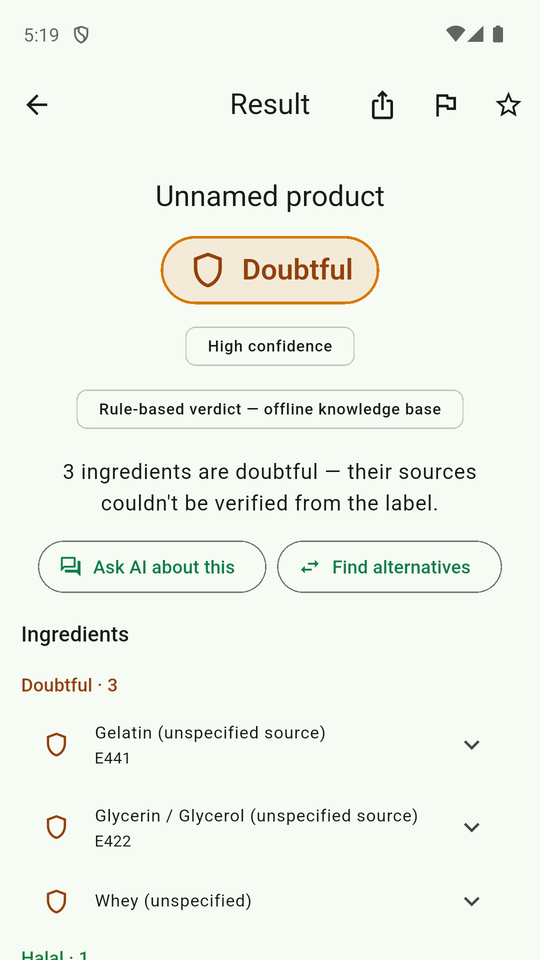
- It reads the list the way steps 2 to 4 do. E-numbers are expanded, sub-ingredients are split out, and each ingredient is checked against a curated knowledge base of 331 entries. Only ingredients the knowledge base doesn't recognise are classified by an AI model, which can't override it and is instructed never to guess Halal and to default to Doubtful or Unknown.
- You get one of four verdicts, always shown as an icon and a word. One haram ingredient makes the product Haram, one doubtful ingredient makes it Doubtful, and Halal appears only when every ingredient is recognised as halal. Each ingredient is listed with its E-number and expands to show the reason for its verdict.
- Steps 1 and 5 are built in. If Open Food Facts lists the product as halal, the result shows a chip reading “Manufacturer claims halal certification — verify the certifier”; it's never treated as proof. For source-dependent ingredients, the result suggests questions for the manufacturer.
- Re-checks work offline. Products you've scanned before resolve without a connection, and the bundled knowledge base gives a rule-based verdict when the server can't be reached. AI analysis needs internet.
You can also tune it to your practice. Settings for strict zabiha, wine vinegar, trace alcohol and a personal watchlist change the verdicts you see, only ever making them stricter. SahihScan will be free to try; a Pro subscription (weekly or annual, annual with a 3-day free trial) adds unlimited scans, Restaurant Mode and the Halal Assistant.
Please note: SahihScan provides ingredient information, not religious rulings. Formulations change — when in doubt, check with the manufacturer or a qualified scholar.
SahihScan's ingredient knowledge base is still undergoing scholarly review. Certifiers are named for their published guidance only, which does not imply endorsement or partnership.
Frequently asked questions
Can I trust the word 'halal' printed on a package?
Treat it as the manufacturer's claim until you can verify it. A certification mark should name the body that issued it, and you can confirm the product on that certifier's own website or by contacting them. If no body is named, or you can't verify it, read the ingredients as if there were no mark.
Is vegan or vegetarian food automatically halal?
Not automatically, though a vegan label helps. It means there are no animal ingredients, so the questions about gelatin, lard, rennet and animal fats disappear. Neither label addresses alcohol, such as wine used as an ingredient or flavourings carried in ethanol, so check for those separately.
What does Mashbooh mean?
Mashbooh means doubtful. An ingredient is Mashbooh when it could come from a permissible or a non-permissible source and the label doesn't say which, as with unspecified gelatin or E471. Many Muslims avoid Mashbooh items until the source is confirmed; how strictly to apply that is a question for a qualified scholar.
How do I find out where an ingredient comes from?
Contact the manufacturer using the customer-care details on the pack. Name the specific ingredient and ask whether it is plant-based, microbial, synthetic or animal-derived, and if it is animal-derived, which animal and how it was slaughtered. Ask whether the answer applies to the version sold in your country.